



Greek Islands Ferry Map
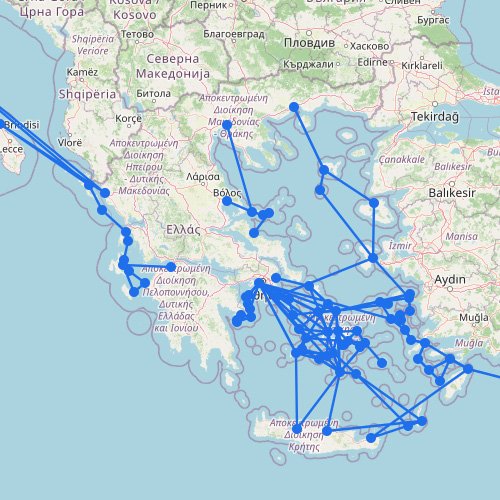
The ferry map above makes the Greek Islands look like one huge connected network. In practice, it is better to think in island groups. The Cyclades, Dodecanese, Ionian Islands, Saronic Islands and Sporades all have their own hubs, ferry companies, sailing patterns and weak links.
That is what makes Greek ferry planning so interesting, but also a bit confusing. Two islands can look close on the map and still be awkward to combine, while another route that looks longer may be much easier because it follows a regular ferry corridor. For most trips, the trick is not to start with the island you like most, but with the right ferry hub.
Piraeus is the main Athens gateway for the Cyclades, Dodecanese, Saronic Islands and Crete. Rafina is often useful for islands such as Andros, Tinos and Mykonos, while Lavrio works well for Kea, Kythnos and some quieter Cyclades routes. If you are heading west to Corfu, Kefalonia or Zakynthos, you are in a completely different ferry system again, with mainland ports such as Igoumenitsa, Kyllini and Patras becoming more important.
Explore ferry routes across the Greek Islands
How to plan ferries across the Greek Islands
On the map, the Greek Islands can look like one big connected ferry network. In practice, it is better to think in island groups first. The Cyclades, Dodecanese, Ionian Islands, Saronic Islands and Sporades all have their own hubs, ferry companies, sailing patterns and weak links.
That is the main thing to understand before planning a Greek island-hopping trip. Two islands can look close together on the map and still be awkward to combine. Another route may look longer, but work much better because it follows a regular ferry corridor. The best Greek ferry route is therefore not always the shortest line on the map.
Choose the right Greek island ferry region
Cyclades ferries are the classic island-hopping routes. This is where you find islands such as Santorini, Mykonos, Paros, Naxos, Milos, Ios and Syros. If you want a flexible multi-island trip with lots of ferry options, this is usually the easiest place to start.
Dodecanese ferries cover the longer routes in the eastern Aegean, including islands such as Rhodes, Kos, Patmos, Kalymnos and Symi. These crossings can be much longer than Cyclades routes, so check whether you are booking a fast ferry, a conventional ferry or an overnight sailing.
Ionian Islands ferries work differently again. Islands such as Corfu, Kefalonia and Zakynthos are mainly reached from western mainland ports such as Igoumenitsa, Kyllini and Patras. Do not plan them as if they are part of the Athens / Aegean island-hopping network.
Saronic Islands ferries are the easiest option for a short island trip from Athens. Aegina, Agistri, Poros, Hydra and Spetses are close enough for shorter crossings, which makes this region useful if you want a Greek island feel without committing to a long Aegean ferry journey.
Sporades ferries connect islands such as Skiathos, Skopelos and Alonissos with mainland ports including Volos and Agios Konstantinos. This is a more compact network than the Cyclades, but schedules still become much thinner outside the main summer season.
Main Greek ferry hubs
For many Greek island trips, the smartest way to plan is to start with the hub, not the island. Piraeus is the main Athens ferry port and the biggest gateway for the Cyclades, Dodecanese, Saronic Islands and Crete. Rafina can be more convenient for Andros, Tinos and Mykonos, especially if you are staying on the eastern side of Athens or arriving via Athens Airport. Lavrio is useful for Kea, Kythnos and some quieter Cyclades routes.
For the Ionian Islands, the logic changes completely. Igoumenitsa is important for Corfu, while Kyllini and Patras are key ports for islands such as Kefalonia and Zakynthos. This is why it often helps to choose the island group first, then the mainland port, and only then the exact ferry route.
Practical Greek ferry tips
- Plan by island group: Greek ferry routes usually work best when you stay within one island group instead of jumping randomly across the map.
- Find the main hub first: Piraeus, Rafina, Lavrio, Igoumenitsa, Kyllini, Patras, Volos and Heraklion all serve different parts of the network.
- Do not rely only on distance: nearby islands do not always have direct ferries, while longer-looking routes may have better schedules.
- Book summer ferries early: July and August are peak months, especially for Santorini, Mykonos, Paros, Naxos, Crete and Rhodes.
- Check the vessel type: high-speed ferries are faster, but conventional ferries are often more comfortable and can be better in windy conditions.
- Allow buffer time before flights: strong Aegean winds can delay or cancel ferries, especially fast boats.
Quick verdict
The Greek ferry network is excellent, but it rewards a bit of route logic. For classic island hopping, start with the Cyclades. For a short island escape from Athens, look at the Saronic Islands. For longer eastern Aegean routes, the Dodecanese make more sense. And for Corfu, Kefalonia and Zakynthos, forget the Athens ferry mindset and plan through the Ionian Islands instead.
In other words: do not just pick two islands because they look close on the map. Find the main ferry corridor first, then build your island route around that.