
Athens has three main ferry ports: Piraeus, Rafina and Lavrio. They are not interchangeable. Each serves a different mix of islands, and the right one depends on whether you are arriving at Athens Airport, staying in the city or travelling with a car.
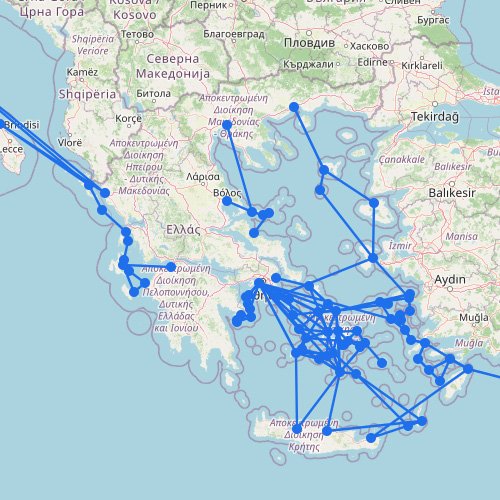
Start by finding your island on the Greek Islands ferry map, then compare the ports on the complete journey: transfer, check-in, crossing and what your options are if a sailing is cancelled. Not just the time at sea.
Quick verdict: choose Piraeus for the widest route choice, a direct metro from both the airport and central Athens, and the best fallback options when a sailing is cancelled. Choose Rafina for Andros, Tinos or Mykonos when arriving by air: the airport transfer takes 25-30 minutes instead of an hour. Choose Lavrio mainly for Kea and Kythnos.
Piraeus, Rafina and Lavrio compared
| Port | Usually best for | From Athens Airport | From central Athens | Main drawback |
|---|---|---|---|---|
| Piraeus | The broadest choice: Cyclades, Crete, Dodecanese, Saronic islands, eastern Aegean | Direct metro (Line 3), about 60 minutes, €9. X96 bus 60-90 minutes | Direct metro, 15-25 minutes from the centre | Gates E1-E12 stretch along several kilometres of waterfront |
| Rafina | Andros, Tinos, Mykonos and seasonal Cyclades routes | Taxi 25-30 minutes (around €35-40 by day), or direct KTEL bus, 30-40 minutes, roughly hourly | Bus, taxi or transfer only; no metro | Fewer fallback sailings when weather cancels a fast ferry |
| Lavrio | Kea, Kythnos and selected Cyclades and northern Aegean routes | Taxi 35-40 minutes; bus requires a change at Markopoulo | Bus, taxi or transfer; about an hour by road | Fewest departures and the weakest public transport links |
Piraeus: the main ferry port for Athens
Piraeus is Greece’s largest passenger port and the departure point for the widest range of islands: the Cyclades (Syros, Paros, Naxos, Mykonos, Tinos, Ios, Santorini), Crete (Heraklion, Chania), the Dodecanese (Rhodes, Kos and many smaller islands), the Saronic islands (Aegina, Poros, Hydra, Spetses) and the eastern Aegean (Chios, Lesvos, Ikaria, Samos).
It is also the only port with a direct metro connection from both central Athens and Athens Airport, which makes it the most predictable choice when you are spending a night in the city first, or when your island is only served by a small number of long-distance ferries.
The Piraeus gate system, explained
Piraeus is not one compact terminal. The departure gates are numbered E1 to E12 and stretch along several kilometres of waterfront; walking from one end to the other can take 30-45 minutes. The metro leaves you near the central gates used by most Cyclades ferries, but other island groups depart from further away. As a rule of thumb:
- E1: Dodecanese ferries (Rhodes, Kos), at the far northern end and the longest walk from the metro.
- E2: north-east Aegean sailings (Chios, Lesvos) and some Crete departures.
- E2-E3: the main Crete gates for Heraklion and Chania, with E3 as the vehicle entrance.
- E4-E7: most Cyclades sailings, with E6 and E7 closest to the metro station.
- E8-E9: Saronic island catamarans and hydrofoils.
- E9-E10: western Cyclades (Milos, Sifnos, Serifos) and some Samos and Ikaria sailings.
Gate assignments do shift, so treat this as orientation rather than gospel. Check your gate the evening before you sail, not on arrival: it appears on your ticket or in the operator’s app, and it determines whether you need ten minutes or half an hour after stepping off the metro. A free shuttle bus connects the gates, and electronic boards at the entrances show live departures. With children, heavy luggage or an E1 departure, allow real extra time.
Rafina: often best from Athens Airport
Rafina sits on the eastern side of Attica, only about 16 km from Athens Airport. That is the whole argument: a taxi takes 25-30 minutes (around €35-40 by day as of summer 2026), and a direct KTEL bus runs roughly hourly for a few euros. Reaching Piraeus from the airport takes about an hour by metro, longer by bus.
Rafina is one of the main gateways to the northern Cyclades, with particularly strong links to Andros, Tinos and Mykonos. The sea route is shorter too: fast ferries reach Mykonos in around 2 hours 15 minutes, against roughly 2 hours 40 minutes from Piraeus. Depending on the season, sailings continue toward Paros, Naxos, Ios and Santorini; those longer routes change between seasons, so check your exact date.
The port itself is compact and easy to read once you arrive, with cafes, restaurants and accommodation around the harbour. Two caveats. First, there is no metro or train, so from central Athens you need a bus, taxi or transfer. Second, Rafina’s east-facing position means summer meltemi winds hit crossings early; on rough days, high-speed sailings from Rafina are among the first to be cancelled. More on that below.
Lavrio: the specialist option for Kea and Kythnos
Lavrio, in southeastern Attica, has far fewer departures than the other two ports, but for Kea it is the obvious mainland gateway: the crossing takes about an hour, with several sailings a day. Kythnos and, depending on the current schedule, islands such as Syros, Tinos, Andros, Lemnos and Agios Efstratios can also be served from here.
From Athens Airport it is about 35 km, or 35-40 minutes by taxi. Public transport is the weak point: the regional bus involves a change at Markopoulo and runs daytime hours only, so for an early departure or late arrival a taxi or prebooked transfer is usually the realistic option. Choose Lavrio because it has the right ferry, not because it looks close to the airport on a map.
What if your sailing is cancelled?
This is the factor most port comparisons skip, and it can matter more than 25 minutes of crossing time. When the meltemi blows in July and August, high-speed ferries are cancelled first, and Rafina’s exposed east-coast departures are often among them.
From Piraeus, a cancellation usually leaves you options: multiple operators, conventional ferries that still sail in stronger wind, and often another departure the same day. From Rafina the alternatives are thinner, and from Lavrio thinner still. If your onward plans are tight, a connecting flight home, one fixed hotel night, Piraeus buys you resilience that no schedule comparison shows. If your plans are flexible, Rafina’s speed advantage stands.
Piraeus or Rafina for Mykonos and Tinos?
Both ports serve Mykonos and Tinos, which makes this the most common Athens port decision. The numbers, as a summer 2026 snapshot:
| From Rafina | From Piraeus | |
|---|---|---|
| Fast ferry to Mykonos | Around 2h15 | Around 2h40 |
| Conventional ferry | Around 4h30, usually via Andros and Tinos | 4h40 to 5h50, often via Syros or Tinos |
| Transfer from the airport | 25-40 minutes by taxi or direct bus | About 60 minutes by metro |
| Transfer from central Athens | Bus or taxi across the city | Direct metro |
| Taking a car (indicative, summer 2026) | Car fares from around €74 | Car fares from around €128 |
In short: arriving by air, or taking a car, Rafina usually wins. Staying in central Athens, wanting a direct metro connection, or combining Mykonos with islands that only sail from Piraeus, choose Piraeus. And if a missed or cancelled sailing would wreck your plans, weigh Piraeus even when Rafina looks faster on paper.
How much time between a flight and a ferry?
A flight-to-ferry connection includes more than the road journey: taxiing to the gate, immigration, baggage, the transfer itself and ferry check-in. As a practical FerryGoGo guideline after an international flight:
- For Rafina: leave at least four hours between scheduled landing and ferry departure. Add more with checked luggage or in peak summer.
- For Piraeus: leave at least five hours, particularly when your ferry leaves from a distant gate such as E1.
- For Lavrio: leave at least five hours with a prebooked transfer. Public transport needs more margin.
These are planning buffers, not guaranteed connection times. When the ferry really matters and there is no later departure, a night on the mainland is the safer choice: near the airport for a morning Rafina or Lavrio sailing, in Piraeus for an early ferry from there. Do not assume a late-evening arrival can still catch a boat; most island routes leave in the morning, and the regional buses to Rafina and Lavrio stop in the evening.
Travelling with a car
Many conventional ferries from all three ports carry vehicles, but not every high-speed vessel has a car deck, so check the vessel before booking. A few practical points:
- Enter complete dimensions: include roof boxes, bike racks and trailers.
- Check your rental agreement: some rental companies restrict taking cars on ferries or to the islands.
- Arrive earlier: vehicle boarding starts before foot-passenger boarding on many sailings.
- Pack a separate bag: the vehicle deck is normally closed during the crossing.
- Confirm the gate: at Piraeus, vehicles for Crete use gate E3, and other routes have their own vehicle entrances.
Conventional ferry or high-speed ferry?
The port decision and the vessel decision are connected. High-speed ferries cut the time at sea but cost more, feel rougher in wind and are the first to be cancelled in bad weather; some carry vehicles, others are passenger-only. Conventional ferries take longer but offer outside decks, more space, better stability and bigger car decks; on a longer crossing they can be a relaxed part of the trip rather than lost time. Compare the whole journey, not the advertised sailing time.
Final checklist
- Confirm which ports serve your island on your exact travel date.
- Check the departure gate the evening before, especially at Piraeus.
- Allow a realistic buffer after an incoming flight: four hours for Rafina, five for Piraeus or Lavrio.
- Check whether your sailing carries vehicles, and what your fallback is if it is cancelled.
- Follow the operator’s check-in deadline, and add time in July, August and holiday weekends.
For most travellers the decision is straightforward: Piraeus for the broadest network, the metro and the best fallback options; Rafina as the faster airport gateway to the northern Cyclades; Lavrio for Kea and Kythnos. Use the Greek Islands ferry map to identify your routes first, then choose the port that produces the best complete journey.
Route networks, gates and transfer times were checked against Athens International Airport, the Piraeus and Lavrio port authorities and current operator schedules in July 2026. Transfer costs and fares are summer 2026 snapshots and change by season; always check your exact date.